
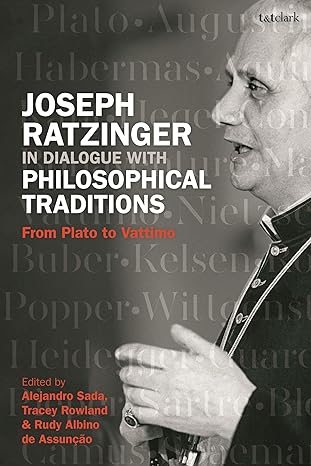
 | Joseph Ratzinger in Dialogue with Philosophical Traditions: From Plato to Vattimo by Tracey Rowland (Editor), Alejandro Sada (Editor), Rudy Albino de Assunção (Editor). T&T Clark (February 22, 2024). 424 pgs. This book extensively explores the various influences and connections between Joseph Ratzinger and a number of leading philosophers; engaging with his work by means of Spanish, Portuguese, German, and English schools of thought through the contributions of a global body of scholars.
Each chapter in this volume examines precisely how Ratzinger has dealt with the ideas of a particular philosopher, and how he has appropriated their ideas and thoughts. Moving from philosophers he has modified or critiqued – such as Kant, Comte or Wittgenstein – to those who have contributed to his philosophical theology, such as Guardini and Pieper, this truly international endeavour is an extraordinary journey into Ratzinger's engagement with his competing and congenial schools of thought. |
 | The Cambridge Companion to Joseph Ratzinger (Cambridge Companions to Religion) by Daniel Cardó (Editor). Cambridge University Press (December 21, 2023). 388 pgs. Among the most important modern Catholic thinkers, Joseph Ratzinger, later Pope Benedict XVI, fundamentally shaped Christian theology in the 20th and early 21st centuries. His collaborations and debates with figures such as Henri de Lubac, Karl Rahner, Jean Daniélou, Hans Küng, Hans Urs von Balthasar, and Jürgen Habermas reflect the key role he has played in the development of Christian life and doctrine. The Cambridge Companion to Joseph Ratzinger conveys the depth and breadth of his significant legacy to contemporary Catholic theology and culture. With contributions from an international team of scholars, the volume assesses Ratzinger's theological synthesis in response to contemporary challenges that Christianity faces. It surveys the major themes and topics that Ratzinger explored, and highlights aspects of the ideas that he developed in his engagement with a wide variety of intellectual and religious currents. Collectively, the essays in this volume demonstrate how Ratzinger's epochal contributions to Christian thought will reverberate for generations to come.
|
 | The Dynamics of the Liturgy: Joseph Ratzinger's Theology of Liturgy by Fr. D. Vincent Twomey. Ignatius Press (October 22, 2022). 187 pgs. The Dynamics of the Liturgy is a constructive critique of the post–Vatican II liturgical reform through the lens of Joseph Ratzinger's liturgical and sacramental theology—written by a former student of the great pope emeritus. For Ratzinger, liturgy is the oxygen of the sacraments, and his sacramental theology, still largely unknown, is the key to understanding his theology of liturgy.
This work highlights the specifically ritual dimension of liturgy, and the significance this has for Pope Benedict XVI's proposed "reform of the reform". Father Vincent Twomey warns that the Ordinary and Extraordinary Forms of the Roman Rite—which Pope Benedict XVI had promoted to enrich liturgical practice—are dangerously drifting apart rather than, as the pope emeritus intended, complementing each other as part of an authentic renewal of the liturgy. |
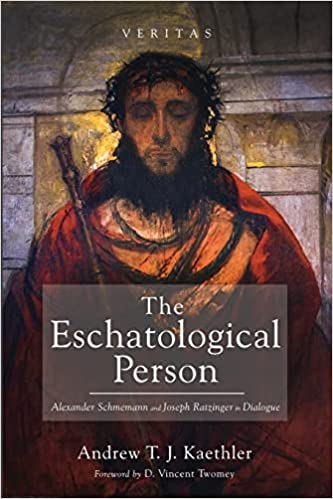 | The Eschatological Person: Alexander Schmemann and Joseph Ratzinger in Dialogue by by Andrew T. J. Kaethler (Author), D. Vincent Twomey (Contributor). Cascade Books (July 12, 2022). 240 pgs. Both Alexander Schmemann and Joseph Ratzinger insist that the human person remains shrouded in mystery without God’s self-disclosure in the person of Jesus Christ. Like us, Jesus lived in a particular time and location, and therefore time and temporality must be part of the ontological question of what it means to be a human person. Yet, Jesus, the one who has time for us, ascended to the Father, and the bride of Christ awaits his return, and therefore time and temporality are conditioned by the eschatological. With this in mind, the ontological question of personhood and temporality is a question that concerns eschatology: how does eschatology shape personhood? Bringing together Schmemann and Ratzinger in a theological dialogue for the first time, this book explores their respective approaches and answers to the aforementioned question. While the two theologians share much in common, it is only Ratzinger’s relational ontological approach that, by being consistently relational from top to bottom, consistently preserves the meaningfulness of temporal existence. |
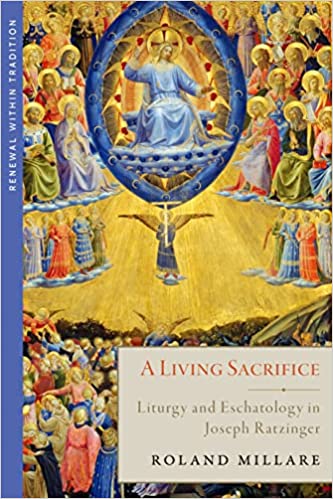 | A Living Sacrifice: Liturgy and Eschatology in Joseph Ratzinger by Roland Millare. Emmaus Academic (June 6, 2022). 336 pgs. A Living Sacrifice focuses on the inherent relationship between eschatology and the liturgy in light of Ratzinger's insistence upon the primacy of logos over ethos. When logos is subordinated to ethos, the human person becomes subjected to a materialist ontology that leads to an ethos that is concerned above all by utility and progress, which affects one's approach to understanding the liturgy and eschatology. How a person celebrates the liturgy becomes subject to the individual whim of one person or a group of people. Eschatology is reduced to addressing the temporal needs of a society guided by a narrow conception of hope or political theology. If the human person wants to understand his authentic sacramental logos, then he must first turn to Christ the incarnate Logos, who reveals to him that he is created for a loving relationship with God and others. The primacy of logos is the central hermeneutical key to understanding the unique vision of Ratzinger's Christocentric liturgical theology and eschatology. This is coupled with a study of Ratzinger's spiritual Christology with a focus on how it influences his theology of liturgy and eschatology through the notions of participation and communion in Christ's sacrificial love. Finally, A Living Sacrifice examines Ratzinger's theology of hope, charity, and beauty, as well as his understanding of active participation in relationship to the eschatological and cosmic characteristics of the sacred liturgy. |
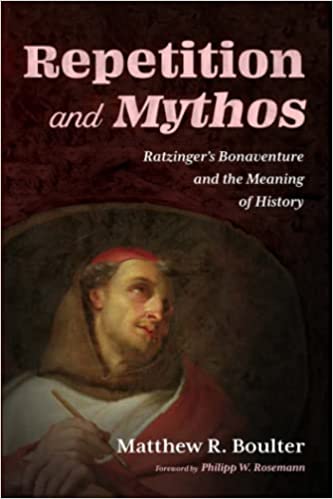
| Repetition and Mythos: Ratzinger's Bonaventure and the Meaning of History by Matthew R. Boulter (Author), Philipp W. Rosemann (Contributor). Pickwick Publications (February 3, 2022). 304 pgs. Writing his Habilitationsschrift as a young man in the late 1950s, future Pontiff Joseph Ratzinger argues that, when St. Bonaventure composed his Collationes in Hexaëmeron in the spring of 1273, not since St. Augustine’s De Civitate Dei contra Paganos had the world seen such a ground-breaking work on the logos of history. Indeed, for Ratzinger’s Bonaventure, history is “first philosophy.” The thirteenth-century Franciscan rails against the widespread assumption, rooted the newly “rediscovered” Aristotle, of history’s unintelligibility. For Bonaventure, mythos mediates the difference between science and history, yielding a non-positivistic approach to the latter. Building on the dynamics of Plato’s Line, Boulter show that the days of creation, narrated by Bonaventure, structure both history and thought. Because, like a story, it has beginning and end, history as a whole can be grasped. Hence, eschatological knowledge of the end of the world is possible. Yet this work also shows how the false “progress myths” of modernity are counterfeit versions of true, spiritual advancement of the kind embodied by saints such as Francis and Bonaventure himself. What is the logos of history? It turns out that it is mythos.
|
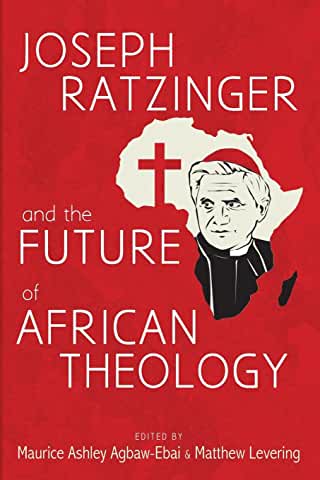 | Joseph Ratzinger and the Future of African Theology by Maurice Ashley Agbaw-Ebai (Editor), Matthew Levering (Editor) Pickwick Publications (December 27, 2021) 270 pgs. This book engages the theology of Joseph Ratzinger/Pope Benedict XVI in dialogue with African Catholic theological concerns and challenges. After an Introduction by Matthew Levering arguing that African Catholic theology is an important resource for the whole Church, the book contains ten chapters by African and non-African Catholic theologians. Paulinus Odozor investigates whether and, if so, how the God of Jesus Christ stands in continuity with the God known to African Traditional Religions. Paul Ọlátúbọsún Àdajà addresses faith and reason in light of the current African anthropological crisis. Tegha Nji and Valery Akoh connect Ratzinger’s idea of “pro-existence” with traditional African understandings of solidarity. Jacob Phillips compares the theologies of Robert Cardinal Sarah and Joseph Ratzinger/Benedict XVI. Dennis Kasule examines the requirements of a New Evangelization for Africa, in light of the case of Uganda. Joseph Lugalambi proposes that the Catholic liturgies of Africa are in need of reform. Mary-Reginald N. Anibueze explores the Eucharist as a socio-communitarian event. Emery de Gaál reflects upon Ratzinger/Benedict’s theology of inculturation. Joseph Ogbonnaya treats Caritas in Veritate with a focus upon the case of Nigeria. Maurice Ashley Agbaw-Ebai meditates upon Ratzinger’s understanding of political power.
|
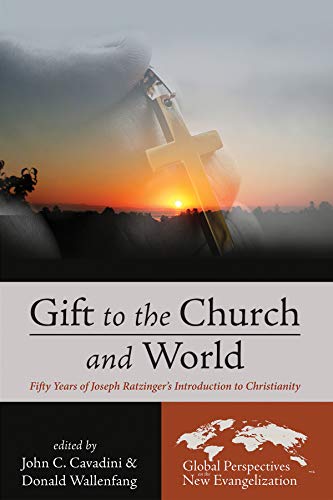 | Gift to the Church and World: Fifty Years of Joseph Ratzinger’s Introduction to Christianity by John C. Cavadini (Author), Donald Wallenfang (Editor) Pickwick Publications (April 4, 2021) 361 pages. Few books in theology have faced the twentieth century with all its horrors and yet convincingly revoiced the redemptive Christian antidote that compels us to reawaken to our true identity as beloved children of God. Joseph Ratzinger's 1968 masterpiece, Introduction to Christianity, is one of those rare books. On the fiftieth anniversary of this classic book's publication, English-speaking scholars from around the globe gathered at the University of Notre Dame to celebrate Ratzinger's lasting influence on the world of Christian theology. Bishops, priests, and lay men and women set their hands to "the trowel of tribute," honoring the theological legacy of Joseph Ratzinger and the pivotal role he has played in the recent history of the Catholic Church, from his early days as a parish priest and university professor, all the way to his election to the Chair of Saint Peter as Pope Benedict XVI. Readers of this collection, Gift to the Church and World, will enjoy the beautiful variety of essays penned by notable scholars that decorate the timeless insights of Ratzinger's theological genius. Thematic topics include an overview and context of Ratzinger's work, fundamental theology, philosophical theology, dogmatic theology, spiritual theology, and pedagogy. Altogether, readers will deepen their appreciation and understanding of the theological contributions of Joseph Ratzinger to the mission field of the New Evangelization today.
|
 | Primacy of Christ: The Patristic Patrimony in Joseph Ratzinger/Benedict XVI's Analogy in Theology Pickwick Publications (March 2, 2021) 276 pgs. What comes to mind when you hear the term “primacy of Christ”? Perhaps that Jesus is number one, or that he is the Lord of the universe? Using the wealth of our tradition on Christ’s primacy, this book compels us to pause and search the profound depths of our basic Christian claim on the universal preeminence of Christ. Upholding the writings of Joseph Ratzinger/Pope Benedict XVI as exemplary representation of how the early Christian awareness of Christ’s primacy helps us to interpret the present age, this book displays a symphonic harmony between our ancient Christian heritage and the ongoing conversations about the authentic interpretation of Scripture, the human person, the last things, and the church. Central to this symphonic harmony of our tradition is the use of analogy whereby the incarnation helps us to better understand the similarity between the created things and the mystery of God. To better understand how Ratzinger uses the writings of the fathers of the church to draw us more deeply into the depths of Christ is what the correctives offered to some scholars in this book intends to accomplish. What emerges is the ecumenical significance of Joseph Ratzinger’s contribution to the modern debate on analogy of being (analogia entis), identifying Christ’s primacy as the point of synthesis between analogia entis and analogia fidei. |
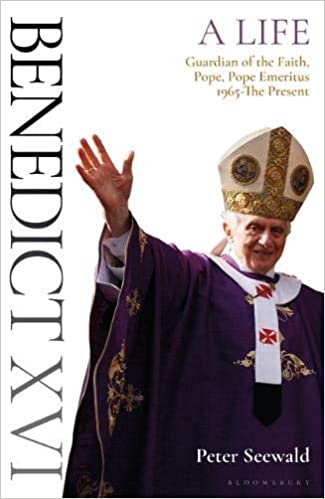 | Benedict XVI: A Life: Volume Two: Guardian of the Faith, Pope, Pope Emeritus 1965–The Present by Peter Seewald. Bloomsbury Continuum (October 12, 2021). 400 pages. Benedict XVI: Volume One offers insight into the young life and rise through the Church's ranks of a man who would become a hero and a lightning rod for Catholics the world over. Based on countless hours of interviews in Rome with Benedict himself, this much-anticipated two-volume biography is the definitive record of the life of Joseph Ratzinger and the legacy of Pope Benedict XVI.
Volume I follows the early life of the future Pope, from his days growing up in Germany and his conscription into the Hitler Youth during World War II to his career as an academic theologian and eventual Archbishop of Munich. Volume II, to be published in 2021, will cover his move to Rome under Pope John Paul II, his ascension to the papacy, and his controversial retirement and news-making statements under his successor, Pope Francis I. This necessary companion to Benedict's own memoir, Last Testament, is the fullest account to date of the life of a radical Catholic leader who has continued to make news while cloistered in retirement in the Vatican gardens. |
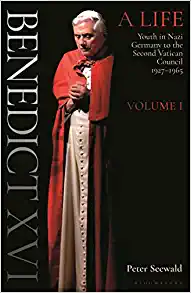 | Benedict XVI: A Life: Volume One: Youth in Nazi Germany to the Second Vatican Council 1927–1965 by Peter Seewald. Bloomsbury Continuum (December 15, 2020). 512 pages. Benedict XVI: Volume One offers insight into the young life and rise through the Church's ranks of a man who would become a hero and a lightning rod for Catholics the world over. Based on countless hours of interviews in Rome with Benedict himself, this much-anticipated two-volume biography is the definitive record of the life of Joseph Ratzinger and the legacy of Pope Benedict XVI.
Volume I follows the early life of the future Pope, from his days growing up in Germany and his conscription into the Hitler Youth during World War II to his career as an academic theologian and eventual Archbishop of Munich. Volume II, to be published in 2021, will cover his move to Rome under Pope John Paul II, his ascension to the papacy, and his controversial retirement and news-making statements under his successor, Pope Francis I. |
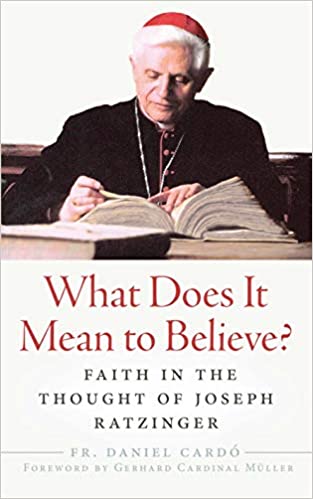 | What Does it Mean to Believe?: Faith in the Thought of Joseph Ratzinger by Fr. Daniel Cardo. Ignatius Pr (November 6, 2018). 715 pgs. The testimony and teachings of Joseph Ratzinger on the act of faith are particularly urgent for the Church today. Doctrinal confusion and other signs of crisis experienced by believers find their root in a crisis of faith. Understanding what it means to believe is more than an academic exercise; rather, it is a necessary step for authentic renewal in the Church.
In What Does it Mean to Believe?, Fr. Daniel Cardó outlines the different insights of Joseph Ratzinger on the act of faith—understood as a personal, integral, and ecclesial act. Cardó provides an organic view of the rich contribution made by the Pope Emeritus in his many theological works. What Does it Mean to Believe? is also an invitation to appreciate the mind and the faith of one of the greatest theologians of our time. |
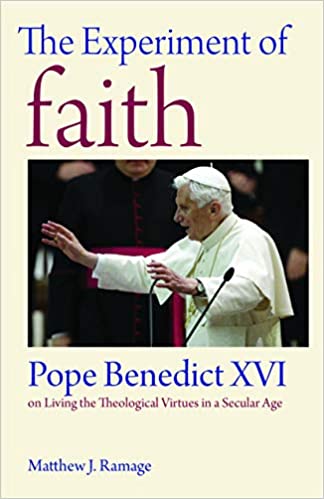 | The Experiment of Faith: Pope Benedict XVI on Living the Theological Virtues in a Secular Age by Matthew J. Ramage. The Catholic University of America Press (March 23, 2020). 304 pages. Pope Benedict XVI memorably remarked that the Christian faith is a lot like a Gothic cathedral with its stained-glass windows. From the outside, the Church can appear dark, dreary, and worn with age—the crumbling relic of an institution that no longer speaks to men and women living in our modern world. Indeed, for many people today, Christian morality with all of its commandments appears to be a source not of life and joy but instead of suffering and oppression. Even within the Church, many wonder: why should I submit to ancient doctrines and outdated practices that restrict my freedom and impede my happiness? In this timely and original book, his third exploring the riches of Benedict XVI's vast corpus, theologian Matthew Ramage sets out to meet this challenge with an in-depth study of the emeritus pontiff's wisdom on how to live Christian discipleship in today's increasingly secularized world. Taking as his starting point Benedict's conviction that the truth of Christianity—like the beauty of a cathedral's glorious windows—can be grasped only from the inside, Ramage draws on Benedict's insights to show how all Christians can make the "experiment of faith" by living the theological virtues of faith, hope, and charity in daily life. Along the way, he shares his personal reflections on how Benedict's wisdom has helped him to navigate difficulties in embracing the faith and provides a way forward to those struggling to live as disciples in a way that is intellectually serious without remaining merely intellectual. In so doing, he also presents a highly nuanced yet accessible approach to defending the truth of the gospel in a world where life in Jesus Christ tends to be seen as unfulfilling, irrelevant, or just one lifestyle choice among others. |
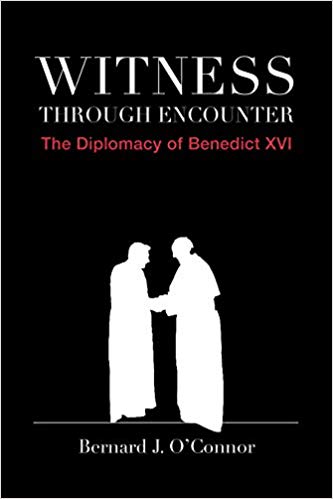 | Witness through Encounter: The Diplomacy of Benedict XVI by Bernard J. O'Connor St. Augustines Press; 1 edition (January 20, 2020). 386 pages. Appealing to dialogue is often just a safe way of referring to something negative, or at best blandly neutral: the avoidance of conflict, the denial of similarity, not stirring deep-seated disagreement, etc. When Bernard o’Connor says pope Benedict XVI facilitated dialogue, however, he means something quite positive, very much tangible and certainly transformative. In providing an account of the pope’s interactions with various groups of the international community, O’Connor attempts to convey Benedict XVI’s diplomacy as encounter, where even in the sphere of international relations exhortations to “dialogue” are invitations to see more clearly and be moved as much as move. To dialogue is to embrace, revise perception such that our approaches to the great questions of our day are not simply shared but correct. As O’Connor writes, “Pope Benedict attempts to promote the outlook that a renewed emphasis upon objective, critical and structured philosophical reasoning positions practice, diplomatic and otherwise, to regain its lost foundation and framework. the quest for integrity, if nothing else, should motivate our fidelity to academic pursuit, to intellectual investigation, and to rigorous interdisciplinary inquiry. so influenced, practice will then reject what is arbitrary and be guided by what is time-tested and enduring.” O’Connor illustrates true dialogue emerging from the encounter, and in turn provides scores of characteristics of this encounter as it unfolds in papal diplomacy. In providing scores of addresses and speeches to various bodies, O’Connor presents pope Benedict XVI as an example of effective diplomacy that treats the meetings on the world stage as engaging in true dialogue. encounter is the true basis of dialogue and one that allows it to open to what is truly a catalyst for change toward cooperation––witness, both personal and collective. As o’Connor shows, “where there is authentic encounter, as meeting in mutual trust, what arises is context for witness.” If authentic even the diplomatic encounter has the means to deepen and transform one’s being. Witness Through Encounter intends to fulfill multiple needs. the diplomatic approach exemplified herein is singular and worthy of study among political scientists, sociologists, philosophers and diplomats eager to embrace a worldview that is more personal than simply humanistic. this work will also be useful in inter-religious settings. An additional advantage of O’Connor’s presentation of Benedict XVI’s diplomatic approach, his witness through encounter, is that it contains insight valuable to the scholar alongside the resources used. |
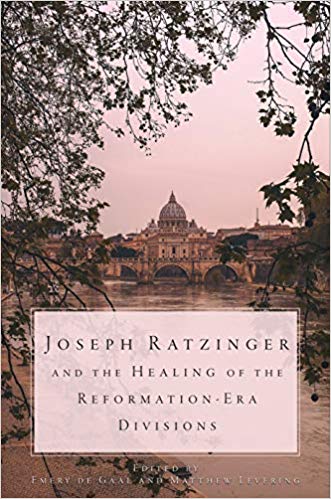 | Joseph Ratzinger and the Healing of Reformation-Era Divisions by Emery de Gaál (Editor) (Author), Matthew Levering (Editor) Publisher: Emmaus Academic (November 1, 2019). 408 pages. Edited by Emery de Gaál and Matthew Levering, Joseph Ratzinger and the Healing of Reformation-Era Divisions examines Joseph Ratzinger/Pope Benedict XVI's manifold contributions to Catholic-Protestant theological reflection. The collection opens with an introduction comparing Ratzinger's approach to ecumenism to that of Karl Rahner. Rahner argues that the structural uniting of Protestants and Catholics should take place now without worrying about doctrinal differences. In contrast, Ratzinger argues that unity in Christ requires probing the doctrinal differences and seeking a deeper understanding of the reasoning of each side—on the grounds that the truth of the Gospel that each side desires to preserve will ultimately be the basis for the only kind of Christian ecclesial unity worth having, namely, a unity of the basis of the truth of the Gospel of Jesus Christ. Detailed essays follow, treating a number of loci including papal primacy, ecumenical principles, liturgy, evangelization, Mariology, Christ's birth and the celebration of Christmas, public theology, Christocentrism, Martin Luther, charity, conscience, missiology, justification, the reception of Ratzinger/Benedict in Radical Orthodoxy, and Scripture and Tradition. These essays run the full gamut of Ratzinger/Benedict's major themes and preoccupations. Ten of the essays are by Catholic scholars, and seven by Protestant scholars. Contributors include many of the world's leading Ratzinger experts, and the volume opens with an essay by Bishop Rudolf Voderholzer, Director of the Pope Benedict XVI Institute in Regensburg, Germany. |
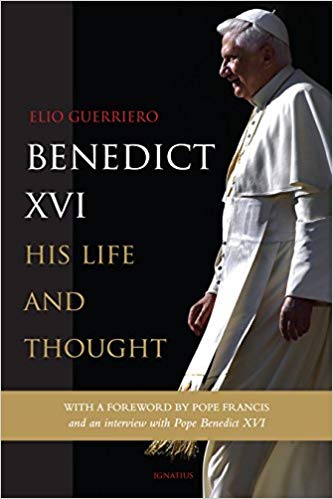 | Benedict XVI: His Life and Thought by Elio Guerriero. Ignatius Pr (November 6, 2018). 715 pgs. In these pages Benedict XVI shares his story for the first time since his retirement from the papacy. Joseph Ratzinger is widely recognized as one of the most brilliant theologians and spiritual leaders of our time. Born in Germany in 1929, he lived through Nazism, war, and Communism, like John Paul II, who after his surprising election in 1978, insisted on having Ratzinger at his side for his whole twenty-seven-year pontificate. When Ratzinger was elected Pope in 2005, he took the name Benedict XVI. He opened a path of purification for the Roman Catholic Church at a time when it was shaken by financial and sexual scandals. He has repeatedly said that Europe must return to its Christian roots and build a new humanism for the twenty-first century. Benedict XVI was misunderstood by many, and in 2013, he astonished the world by resigning from the papacy. Many saw this gesture as a sign of the decline of Catholicism, but it was the opposite: it was a seed sown in the hope of bringing the Church a younger, more vigorous leadership in the face of so many daunting challenges. Elio Guerriero, who for many years has had an ongoing relationship with the Pope Emeritus, presents a thorough, well-rounded portrait of the brilliant intellectual and humble man of the Church whom many more have come to love and respect since his resignation. This book includes a Foreword by Pope Francis, and contains the first interview of Benedict XVI since the end of his pontificate. Elio Guerriero, theologian, philosopher, and historian, is the longtime director of Communio, and editorial manager at Jaca Book and Edizioni San Paolo. He edited the Italian edition of the History of the Church directed by A. Jedin. His other books include Hans Urs von Balthasar, The Drama of God, and Saint Giana Molla: Wife, Mother, and Doctor. |
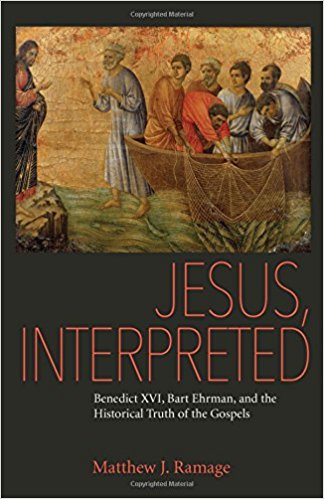 | Jesus, Interpreted: Benedict XVI, Bart Ehrman, and the Historical Truth of the Gospels By Matthew J. Ramage. The Catholic University of America Press (January 19, 2017) 226 pgs. In this sequel volume to his Dark Passages of the Bible (CUA Press, 2013), author Matthew Ramage turns his attention from the Old to the New Testament, now tackling truth claims bearing directly on the heart of the Christian faith cast into doubt by contemporary New Testament scholarship: Did God become man in Jesus, or did the first Christians make Jesus into God? Was Jesus' resurrection a historical event, or rather a myth fabricated by the early Church? Will Jesus indeed return to earth on the last day, or was this merely the naïve expectation of ancient believers that reasonable people today ought to abandon? In addition to examining the exegetical merits of rival answers to these questions, Ramage considers also the philosophical first principles of the exegetes who set out to answer them. This, according to Joseph Ratzinger, is the debate behind the debate in exegesis: whose presuppositions best position us for an accurate understanding of the nature of things in general and of the person of Jesus in particular? Insisting upon the exegetical vision of Joseph Ratzinger/Benedict XVI as a privileged avenue by which to address the thorniest issues in contemporary biblical exegesis, Ramage puts the emeritus pontiff's hermeneutic of faith into dialogue with contemporary exponents of the historical-critical school. Carrying forth the "critique of the critique" called for by Joseph Ratzinger, Ramage offers the emeritus pontiff's exegesis of the gospels as a plausible and attractive alternative to the mainstream agnostic approach exemplified in the work of Bart Ehrman. As in the case of Benedict's Jesus trilogy upon which he draws extensively, Ramage's quest in this book is not merely academic but also existential in nature. Benedict's scholarship represents the fruit of his personal quest for the face of Christ, a quest which involves the commitment to engage, critique, and learn from the most serious challenges posed by modern biblical criticism while arming the foundations of the Christian faith. |
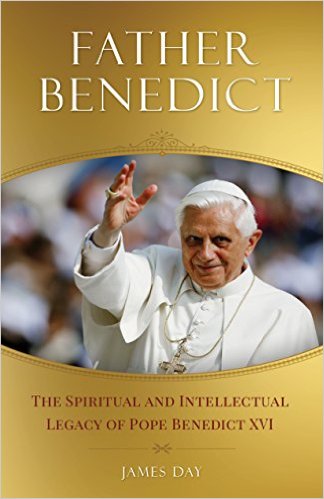 | Father Benedict: The Spiritual and Intellectual Legacy of Pope Benedict XVI by James Day. Sophia Institute Press (November 17, 2016). 160 pages. Pope Benedict XVI is widely considered to be the greatest theologian and Catholic thinker of our time. In these pages, author James Day unpacks the voluminous teachings of Pope Benedict and presents his remedies for the many ills afflicting the Church and our culture, including individualism, materialism, secularism, and godlessness. At a time when the many “isms” of our day are pulling people away from the Faith, Father Benedict presents a hope-filled future, but only if we are to follow the guidance of Pope Benedict and the path he presents to us in every aspect of life: the formation of the Christian faith, in loving others, in personal vocation, in education, and in how we see the natural world. Pope Benedict XVI offers our generation one of the clearest understandings of our world today, tirelessly championing the New Evangelization and a sacramental return to Christ and His Church. Father Benedict offers a compelling case for the Christian way, guiding us through the thoughts and writings of the Bavarian priest who became the Holy Father, and who now simply wishes to be called “Father Benedict.” |
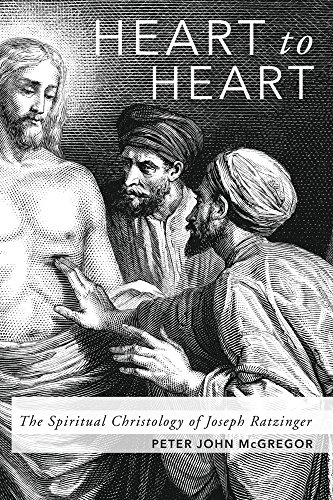 | Heart to Heart: The Spiritual Christology of Joseph Ratzinger by Peter John McGregor. Pickwick Publications (May 13, 2016). 440 pages. In Behold the Pierced One, Joseph Ratzinger recounts how the composition of a 1981 paper on the Sacred Heart of Jesus had led him to "consider Christology more from the aspect of its spiritual appropriation" than he had done previously. Upon realizing that this same year was the 1300th anniversary of the Third Council of Constantinople, he decided to study the pronouncements of this Council, and came to believe "that the achievement of a spiritual Christology had also been the Council's ultimate goal." Ratzinger's conclusion in attempting to define a spiritual Christology was that "the whole of Christology--our speaking of Christ--is nothing other than the interpretation of his prayer: the entire person of Jesus is contained in his prayer." The spiritual Christology subsequently developed by Ratzinger is one of communio. Indeed, it is one of theosis. Through a personal and ecclesial participation in the prayer of Jesus, exercised in purity of heart, and consummated in the eucharistic celebration, one comes into communion with Jesus Christ and all the members of his Body, so that eventually one can say truly, "It is no longer I who live, but Christ who lives in me" (Gal 2:20). |
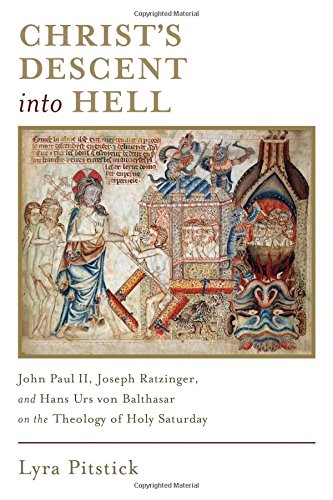 | Christ’s Descent into Hell: John Paul II, Joseph Ratzinger, and Hans Urs von Balthasar on the Theology of Holy Saturday By Lyra Pitstick. Eerdmans (May 17, 2016) 144 pages. Pope John Paul II and Joseph Ratzinger (now Pope Emeritus Benedict XVI) both held Hans Urs von Balthasar in high regard. Many assume that their praise of Balthasar indicates approval of his controversial theology of Holy Saturday, but this book by Lyra Pitstick shows that conclusion to be far from accurate. Pitstick looks at what John Paul II, Ratzinger, and Balthasar have in fact said regarding the creedal affirmation that Christ “descended into hell,” and she shows that there are radical differences in their views. She then addresses a number of important questions that follow from these differences. This careful, concise exploration of what three of the twentieth century’s most famous Catholic theologians had to say about Christ’s descent into hell provides an accessible take on a difficult point of theological debate. |
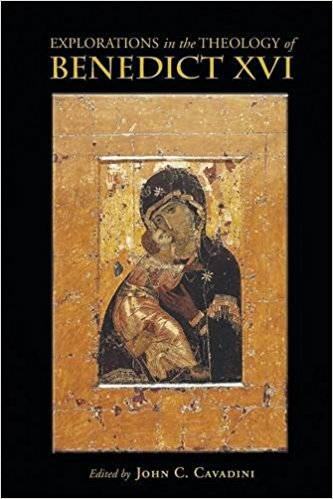 | Explorations in the Theology of Benedict XVI Edited by John C. Cavadini. University of Notre Dame Press; 1 edition (February 28, 2016) 328 pgs. In Explorations in the Theology of Benedict XVI, a multidisciplinary group of scholars treat the full scope of Benedict’s theological oeuvre, including the Augustinian context of his thought, his ecclesiology, his theologically grounded approach to biblical exegesis and Christology, his unfolding of a theology of history and culture, his liturgical and sacramental theology, his theological analysis of political and economic developments, his use of the natural law in ethics and conscience, his commitment to a form of interreligious dialogue from a place of particularity, and his function as a public, catechetical theologian. "If you're looking for a synoptic view of Benedict XVI's theological achievement, this is by a long way the best thing on offer in English. Each of the essays provides a detailed engagement with a central theme in Benedict's theology, treated not merely in isolation but also in terms of its relations to the whole. The result is a profound depiction of the range, scope, and integrated nature of Benedict's theology. This is a volume that honors the thinker it treats by taking him seriously not only as pope, but also as a theologian." —Paul J. Griffiths, Duke Divinity School "This is quite simply the best exploration of Pope Benedict's theology available in English. Some of these essays dig deep into the younger Ratzinger's Augustinian soil and reveal to us the roots of Benedict's papal teaching. Others trace the lines of growth from those roots out to his striking papal encyclicals, and to the apologetics of love that grounds his vision of the Church's task. The fruitfulness of the collection is perhaps most evident in the way that the authors do not simply repeat, but think with and in the light of Benedict’s theology. Above all, this collection displays Benedict’s theology as a personal, living faith and a reasoned faith, as a theology of divine and human love that invites humanity into faith’s re-imagining of human existence." —Lewis Ayres, Durham University |
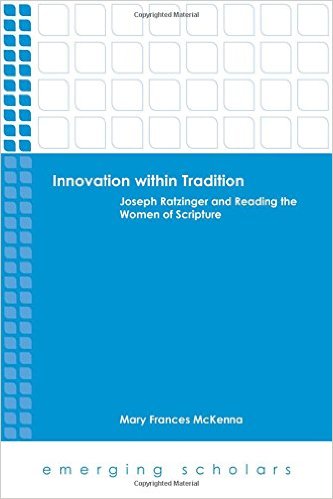 | Innovation within Tradition: Joseph Ratzinger and Reading the Women of Scripture By Mary Frances McKenna. Fortress Press (September 1, 2015) 272 pages. is an exploration of the meaning and implications of Joseph Ratzinger's biblical interpretation of the women of salvation history. Mary Frances McKenna argues that Ratzinger's work, through his development and refinement of the church' tradition, brings the important role and significance of the female characters of Scripture to the fore by placing them at the heart of Christian faith. Explicating the pope emeritus's concept of a "female line in the Bible," which has a profound impact on the meaning and interpretation of the women of salvation history, the volume shows that this concept illustrates the practical value and creative nature of his approach to theology and biblical interpretation. Pivotal to the argument are questions around the findings on the notion of person, feminist theology, salvation history, and Mary, as well as the use of history in theology and biblical interpretation and the potential for the continuing development and deepening of the church's comprehension of the meaning of revelation. The book advances a constructive approach, in coordination with these questions, for a Trinitarian theology of society, addresses old theological issues anew, and provides a starting point for an interdenominational understanding of Mary. Mary Frances McKenna is a tutor for the Centre for Marian Studies at University of Roehampton and chair of the relaunched Dublin (Ireland) branch of the Ecumenical Society of the Blessed Virgin Mary. She received her PhD at All Hallows College, Dublin City University, and her MA and BA in history at University College Dublin. She has published on the topic of faith and knowledge in relation to science and philosophy. This is a revision of a dissertation completed at All Hallows College, Dublin City University, Ireland under Tom Dalzell. |
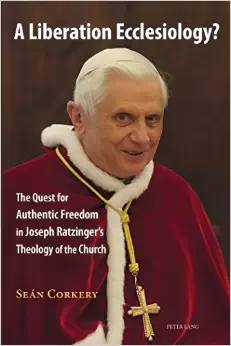 | A Liberation Ecclesiology?: The Quest for Authentic Freedom in Joseph Ratzinger's Theology of the Church By Sean Corkery. Peter Lang Pub Inc (April 29, 2015). 576 pp. Freedom, one of the most potent ideals of the post-Enlightenment era, came to remarkable prominence in ecclesiology through the emergence of liberation theologies in the twentieth century. At the same time, Joseph Ratzinger - a German university professor - was appointed a bishop of the Roman Catholic Church and prefect of the Congregation for the Doctrine of the Faith. His interaction with the pioneers of the liberationist movement led him to engage directly with the Christian understanding of freedom and its significance. As a result, his interest in freedom as a theological question expanded from the 1970s onwards. This book explores whether the basis for a liberation ecclesiology can be attributed to Ratzinger in his own right. While the volume's focus is ecclesiological, the author also gathers together many strands of Ratzinger's core theological insights in an attempt to establish how he approaches an issue that is both provocative and highly topical. Ratzinger is a controversial and engaging figure, and this book is essential reading for those who wish to understand how he deals with a theological topic of ongoing concern to society in general and the Catholic Church in particular. |
 | Faith, Hope, and Charity: Benedict XVI on the Theological Virtues by Thomas P. Rausch Paulist Press (March 17, 2015) Pope Benedict s approach to encyclicals is different from that of his predecessor Pope John Paul II. He is more inclusive in his sources, drawing on non-Christian authors, philosophers, and novelists among them, as well as more traditional works. His encyclicals also differ from his typical theological works; they are more pastoral, at times even conversational, inviting the reader into the mystery of the three theological virtues that frame and inform the Christian life. Deus caritas est explores a God who is both reason (logos) and love, and who loves us passionately, reclaiming eros as a descriptor of God s love. Spe salvi examines the relation between faith and hope, arguing that without faith and its vision of God s justice, hope too easily substitutes a secular idea of progress that often leads to atheism. Lumen fidei, drafted for his successor, Pope Francis, focuses on faith as a light flowing from a personal relationship with God. The book notes how the three encyclicals were received and concludes with reflections on Pope Benedict s theological legacy. |
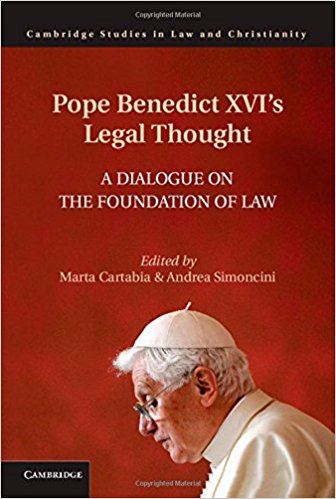 | Pope Benedict XVI's Legal Thought: A Dialogue on the Foundation of Law by Marta Cartabia (Editor), Andrea Simoncini (Editor) Cambridge University Press (March 5, 2015) 256 pages. This book discusses the speeches in which the Pope Emeritus Benedict XVI reflected most explicitly on law, justice, democracy, and reason, along with the commentary from a number of distinguished legal scholars. Collectively, these addresses formulate a series of core ideas for a "public teaching" on the topic of justice and law. |
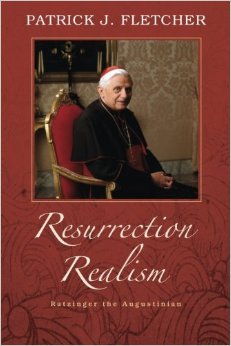 | Resurrection Realism: Ratzinger the Augustinian by Patrick J. Fletcher. Cascade Books (July 21, 2014). In Resurrection Realism, Patrick Fletcher examines the key role played by Joseph Ratzinger, later Pope Benedict XVI (2005-2013), in the lively twentieth-century debates over the resurrection. Since Ratzinger has repeatedly claimed to be a follower of Augustine of Hippo, whose theology of resurrection has been so significant in Western Christianity, this book begins by identifying the key characteristics of that theology before studying Ratzinger's theology of resurrection in detail, examining the original sources of both Ratzinger and his German interlocutors, in order to paint the clearest picture to date of Ratzinger's thought on the resurrection. Some issues dealt with include: the development of Ratzinger's thought, the question of Augustinian duality and Thomistic hylomorphism, the salvation of matter, and the nature and identity of the risen body. |
 | The Logos as Reason, Word, and Love in the Theology of Joseph Ratzinger by John J. Lynch. CreateSpace Independent Publishing Platform (June 11, 2014). 138 pages. The Logos as Reason, Word, and Love in the Theology of Joseph Ratzinger explores the doctrine of the Logos as it can be found in the varied writings of Joseph Ratzinger (Pope Benedict XVI). Specifically, it articulates that the Ratzingerian Logos-doctrine holds that the Divine Word is revealed to humanity through Reason, the Holy Scriptures and the life of Jesus, and through the love of God found reflected in the Christian Church and the beauty of human life and dialogue. |
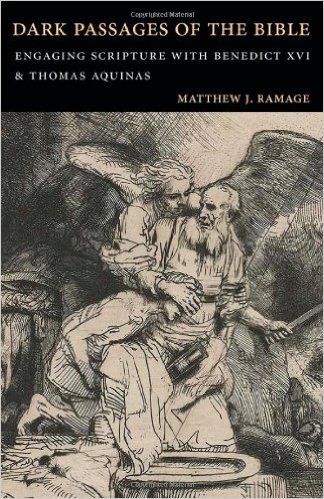 | Dark Passages of the Bible: Engaging Scripture with Benedict XVI and St. Thomas Aquinas By Matthew J. Ramage. The Catholic University of America Press (September 2013). 312 pages. Multiple gods? Divinely mandated genocide? Rejection of an afterlife? If the Scriptures are the inspired and inerrant word of God that Christians claim them to be, how can they contain these things? For many believers in the modern age, traditional Christian answers to these challenges are no longer convincing. Though spiritually edifying, they are unable to account for the sheer scope and depth of problems raised through the advent of historical-critical scholarship. Following the lead of Pope Benedict XVI, in Dark Passages of the Bible Matthew Ramage weds the historical-critical approach with a theological reading of Scripture based in the patristic-medieval tradition. Whereas these two approaches are often viewed as mutually exclusive or even contradictory, Ramage insists that the two are mutually enriching and necessary for doing justice to the Bible's most challenging texts. Ramage applies Benedict XVI's hermeneutical principles to three of the most theologically problematic areas of the Bible: its treatment of God's nature, the nature of good and evil, and the afterlife. Teasing out key hermeneutical principles from the work of Thomas Aquinas, Ramage analyzes each of these themes with an eye to reconciling texts whose presence would seem to violate the doctrines of biblical inspiration and inerrancy. At the same time, Ramage directly addresses the problems of concrete biblical texts in light of both patristic and modern exegetical methods. |
 | Pope Benedict XVI and the Politics of Modernity By Marc D. Guerra. Routledge, October 2013. 168 pages. In Benedict XVI and the Politics of Modernity, distinguished scholars from North America and Europe examine Pope Benedict XVI’s searching reflections on the challenges and prospects facing modern Western society. For more than five decades, Joseph Ratzinger/Pope Benedict XVI has made the subject of the continued health and vitality of Western civilization a focal point of his reflections. From his early (1968) Introduction to Christianity to his later (2005) Values in a Time of Upheaval, the Pope has argued that the preservation of the social, political, scientific, and spiritual way of life that characterizes modern Western societies hinges upon our rediscovery of the unique roots and distinctive nature of Western civilization. Focusing on Pope Benedict XVI’s nuanced account as to why the modern West cannot currently afford to forget or neglect its premodern Hellenic and Christian roots, this book will interest religious and nonreligious people who are concerned about the future of democracy and religion in contemporary Western societies. This book was based on a special issue of Perspectives on Political Science. Marc D. Guerra is associate professor and director of graduate programs in theology at Ave Maria University. He is the author of Christians as Political Animals (ISI Books, 2010) and editor of Reason, Revelation, and Human Affairs; Jerusalem, Athens, and Rome; and The Science of Modern Virtue: Essays on Descartes, Darwin, and Locke. |
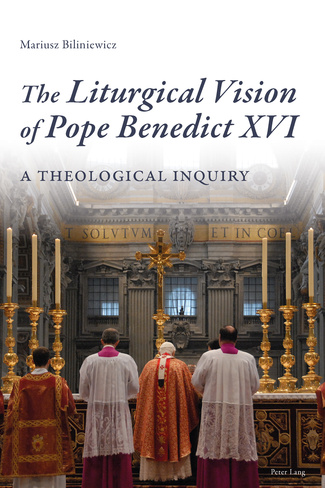 | The Liturgical Vision of Pope Benedict XVI: A Theological Inquiry By Mariusz Biliniewicz. Peter Lang AG, Internationaler Verlag der Wissenschaften (20 Feb 2013). 341 pages. This book presents and evaluates the liturgical vision of Pope Benedict XVI and the theological background underlying that vision. It describes the main features of Joseph Ratzinger's theology of the liturgy and analyses them within the context of his theology as a whole. Ratzinger's evaluation of the contemporary Roman Catholic liturgy is explored in relation to his overall assessment of the post-Vatican II era in the Church, alongside an examination of his project of liturgical renewal ('reform of the reform') and its practical implementation during his pontificate. The author discusses the various critical voices which have been raised against the Pope's liturgical agenda and against certain aspects of his general theology. Overall, the book offers an assessment of the importance of Ratzinger's vision for the Church at the threshold of the third millennium. |
 | The Word Made Love: The Dialogical Theology of Joseph Ratzinger/Benedict XVI by Christopher S. Collins. Liturgical Press, February 2013. In The Word Made Love, Christopher Collins identifies in the structure of Ratzinger s thought the presentation of God as one who speaks and who ultimately speaks Himself in the person of Jesus Christ. Humanity s posture before God is one of hearing and responding. For Ratzinger, then, dialogue is the basic structure of all reality, and the Christian vision articulates the radical transformation that happens when we enter into this divine dialogue. Collins argues that this dialogical, communicative structure is a distinctive aspect of Ratzinger s thought and a unique contribution to the renewal of theology in our day. Christopher S. Collins, SJ, is assistant professor of theology at Saint Louis University. He is a former parish priest on the Pine Ridge Indian Reservation, as well as a high school instructor at both Brophy College Prep in Phoenix, Arizona, and Jesuit College Preparatory in Dallas, Texas. |
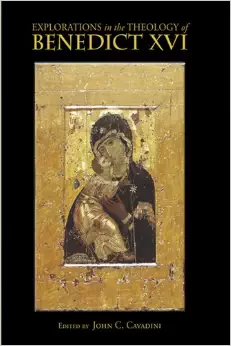 | Explorations in the Theology of Benedict XVI by John C. Cavadini (Editor). University of Notre Dame Press (January 15, 2013). Benedict XVI’s writing as priest-professor, bishop, head of the Congregation for the Doctrine of the Faith, and now pope has shaped Catholic theological thought in the twentieth century. In Explorations in the Theology of Benedict XVI, a multidisciplinary group of scholars treat the full scope of Benedict’s theological oeuvre, including the Augustinian context of his thought; his ecclesiology; his theologically grounded approach to biblical exegesis and Christology; his unfolding of a theology of history and culture; his liturgical and sacramental theology; his theological analysis of political and economic developments; his use of the natural law in ethics and conscience; his commitment to a form of interreligious dialogue from a place of particularity; and his function as a public, catechetical theologian. This volume originated at a conference at the University of Notre Dame on the occasion of the pontiff and theologian’s eighty-fifth birthday. It provides an introduction to Benedict’s ecclesially grounded theology, articulated in his essays, monographs, and sermons, and also serves as a primer in the major concerns of Catholic theological discourse in the twentieth century. Explorations in the Theology of Benedict XVI will be of interest to students in theology; those concerned with the development of a pastoral approach to theology that is simultaneously sophisticated in its thought; theological historians seeking to understand the place of Benedict vis-à-vis twentieth-century intellectual life; and general readers of Benedict’s work. |
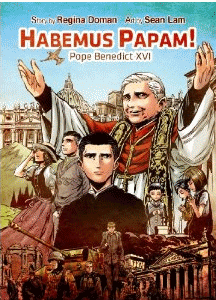 | Habemus Papam! Pope Benedict XVI (Manga Hero, 2012) Habemas Papam! Pope Benedict XVI is the story of an extraordinary young man who thought he was ordinary. Young Josef Ratzinger faces a number of challenges growing up in German Bavaria: all he wants to do is learn, but the Nazis keep closing down his schools. His father, Captain Ratzinger, a retired police officer, has been trying to stay one step ahead of the Nazis, but as Josef grows older, Germany moves towards war, and every German youth must serve in the army Hitler has taken over. Little does Josef realize that the plan God has for him goes beyond books and the academy - and even beyond Germany! This graphic novel about the life of Pope Benedict XVI is an expanded version of Gabrielle Gniewek's book that was officially published for World Youth Day 2011 in Madrid, Spain, and distributed to 300,000 people. Also included is a nine page appendix with fun facts about the Holy Father, his vehicles, and the Swiss Guards. Additional Info
|
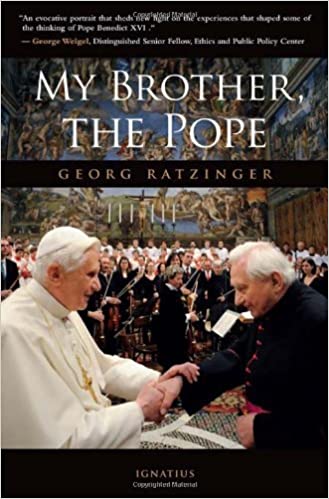 | My Brother, the Pope by Msgr. Georg Ratzinger. Ignatius Press (March 2012) It wasn't always the case that Msgr. Georg Ratzinger lived in the shadow of his younger brother, Joseph. Georg was an accomplished musician, who for over 30 years directed the Regensburger Domspatzchor, the world-famous boys choir of the Regensburg cathedral. Brother Joseph was a brilliant young professor, but mostly known in German academic circles. Now Georg writes about the close friendship that has united these two brothers for more than 80 years. This book is a unique window on an extraordinary family that lived through the difficult period of National Socialism in Germany. Those interested in knowing more about the early life of Benedict XVI will not be disappointed. They will also learn of the admirable character and inspiring example of the parents, and see how the Catholic faith can shape not just a family, but an entire culture-in this case, that of Bavaria. Georg's reminiscences are detailed, intimate, and warm. And while they begin with the earliest years of the Ratzinger family, they continue right up to the present day. Reviews
|
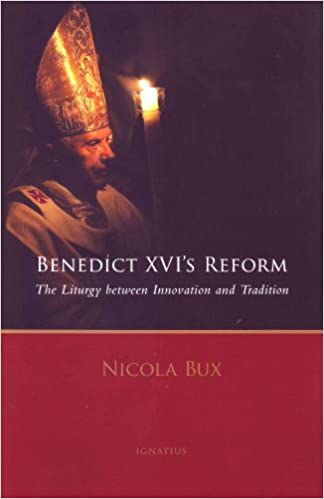 | Benedict XVI's Reform: The Liturgy Between Innovation and Tradition By Nicola Bux. Ignatius Press (April 2012) When Benedict XVI reestablished the celebration of the older Latin Mass, voices of protest rose up from many sides. The widespread fear was-and is-that the Pope had revealed himself as the reactionary defender of tradition that many have accused him of being since he was the prefect of the Congregation for the Doctrine of the Faith, the former Holy Office. Defenders of Benedict XVI have responded to these objections by explaining that the use of the Tridentine Rite is not a "step backward" to pre-Vatican II times, but rather a step forward. Now the Church can see what the older rite offered in terms of beauty, reverence, and meaning and perhaps desire more of those elements in the ordinary form of the Mass. A professor of theology and liturgy, the author of this book explains the motives behind the Pope's decision to allow two forms of the Mass. He does this by turning to the Pope's own theological and liturgical writings, but he also draws from his experiences on various Church commissions and in offices of the Roman Curia. |
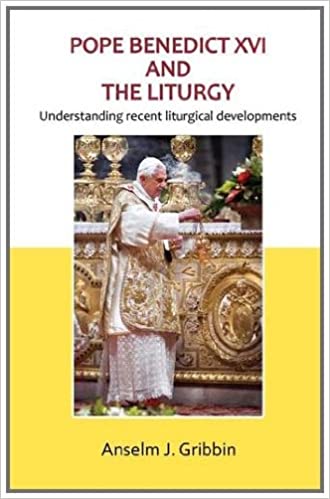 | Pope Benedict XVI and the Liturgy By Anselm J. Gribbin. Gracewing Publishing (May 2, 2011) A prominent and inescapable feature of Pope Benedict XVI's pontificate is the importance which has been given to the sacred liturgy, in its actual celebration, as well as in the pope's Magisterium and theological writings. Not only have we witnessed the reappearance of many elements used in older, but recently-abandoned papal liturgies, but also what amounts to be the virtual liberation of the 'Old Latin Mass'. This has come as a great surprise to many people in the Church, some of whom almost regard it, and the pope's liturgical theology, as a betrayal of recent liturgical reforms. On the other hand, others have viewed these liturgical changes, and the emphasis which Pope Benedict places upon the liturgy in the life of the Church, as positive developments, leading to a more correct understanding of the Second Vatican Council within 'the hermeneutic of continuity' and reform, and the notion of 'organic development'. But, in the midst of conflicting interpretations, how are we to understand these developments and Pope Benedict XVI's re-affirmation of what we now call the usus antiquior? In this book Dr Anselm J. Gribbin explores these and other related questions by examining the liturgical theology of Pope Benedict XVI in his magisterial teachings and writings, particularly in the post-synodal exhortation Sacramentum Caritatis, the motu proprio Summorum Pontificum, and The Spirit of the Liturgy. Gribbin, in an extensive, and detailed analysis, indicates that the liturgical theology of Pope Benedict XVI/Joseph Ratzinger points the way forward for the Church in the field of liturgy. He also addresses the fundamentally important question of the relationship between the liturgical writings of Pope Benedict XVI as a theologian, and his Magisterium as the supreme pontiff of the Catholic Church, and that the latter is best understood with recourse to the former. Dr Anselm J. Gribbin, O.Praem., was born in Glasgow, and is a religious in the Abbey of Tongerlo, Belgium. He studied at St Mary’s College, Strawberry Hill, Maryvale Institute, Birmingham, and received his doctorate from the University of Cambridge. A specialist in Late Medieval History, he has made a particular study of the Premonstratensians and Carthusians, and the liturgical practices of this period. He is a socius member of the Historical Commission of the Premonstratensian Order, and his publications include a co-edited volume of the acta of the archbishops of Canterbury in the English Episcopal Acta Series. |
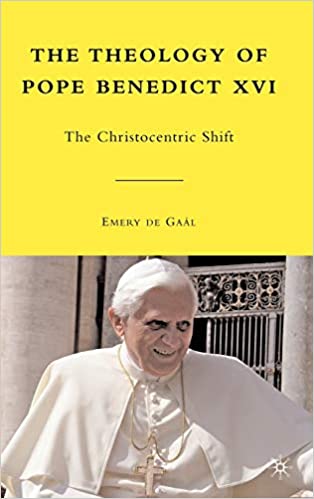 | The Theology of Pope Benedict XVI: The Christocentric Shift By Father Emery de Gaál, Ph.D. Palgrave Macmillan (November 23, 2010) Many refer to Pope Benedict XVI as "the Mozart of Theology." Who are the personalities and thinkers who have informed his theology? What events, and which religious devotions, have shaped his personality? What are the central themes of his complex scholarship encompassing more than 1500 titles? This study attempts to shed light on the unifying melody of the policies and positions of a pontificate charged with spiritual and theological depth. Especially in the 1970s an anthropocentric shift had occurred. Emery de Gaál argues that, amid a general lack of original, secular ideas stirring public opinion, Benedict XVI inaugurates an epochal Christocentric shift; by rekindling the Patristic genius, he provides Christianity with both intellectual legitimacy and the scholarship needed to propel it into the twenty-first century. About the Author Fr. Emery de Gaál is Associate Professor of Systematic Theology at the University of St. Mary of the Lake operated by the Catholic Archdiocese of Chicago and located in Mundelein, Illinois. He studied theology in Munich and Pittsburgh and also published Theology: The Art of Equanimity. He is a Catholic priest of the diocese of Eichstätt, Bavaria, Germany. "Pope Benedict XVI’s theological work and his pastoral and spiritual writings are here placed in the perspective of the mystery of Christ. Father Emery de Gaal has beautifully and exhaustively clarified the fundamental interpretative key to the Ratzinger texts and to the life of Pope Benedict XVI." -- Francis Cardinal George, OMI, Archbishop of Chicago "He was already one of the most important theologians of the past century before his election to the papacy as Benedict XVI in this century. But now Joseph Ratzinger must count as perhaps the most important postconciliar theologian, bar none. de Gaál gives us the most comprehensive study of the pope’s theology now available. But even more, he places the pope’s thought in the context of the revolution in Catholic theology that started well before Vatican II and has continued on to this day: the revolution that abandoned neoscholasticism and shifted its focus to Christology. That story is indeed a dramatic one, and here it is dramatically and comprehensively told. This book is a ‘must purchase’ for every theological library – and for all admirers of that perhaps greatest of great theologians, Joseph Ratzinger." —Fr Edward T. Oakes, S. J., Chester & Margaret Paluch Professor of Theology, University of St. Mary of the Lake/Mundelein Seminary "Father de Gaál’s work is indispensable for anyone who wishes to understand the Christocentric shift in the papacies of John Paul II and Benedict XVI and in contemporary theological anthropology generally. It is the deepest analysis of the topic currently available." — Tracey Rowland, Professor and Dean, John Paul II Institute for Marriage and Family, Melbourne, Australia |
| Benedict XVI: A Guide for the Perplexed By Tracey Rowland. T & T Clark International (July 2010) This title presents an upper-level introduction to the thought and theology of Pope Benedict XVI. This Guide provides students of theology with a guide around the theoretical axes upon which the theology of Joseph Ratzinger revolves. It begins with a presentation of the key ideas in the works of his intellectual antecedents and contemporary interlocutors and then moves to an account of Ratzinger's responses to a number of theological crises. The work then moves to an account of Ratzinger's understanding of Christianity as an encounter with the Person of Christ and his placement of Christianity within the context of world religions in general. This theme is spread throughout his publications and recurs in the first encyclical of his papacy, Deus Caritas Est. This first encyclical will be treated in depth along with the second and third encyclicals which form a trilogy on the theological virtues (love, hope and faith). The work concludes with an assessment of the primacy of the transcendental of beauty in the theology of Ratzinger, his affinity with Hans Urs von Balthasar and the Augustinian motif of the relationship between love and reason. "Continuum's Guides for the Perplexed" are clear, concise and accessible introductions to thinkers, writers and subjects that students and readers can find especially challenging - or indeed downright bewildering. Concentrating specifically on what it is that makes the subject difficult to grasp, these books explain and explore key themes and ideas, guiding the reader towards a thorough understanding of demanding material. |
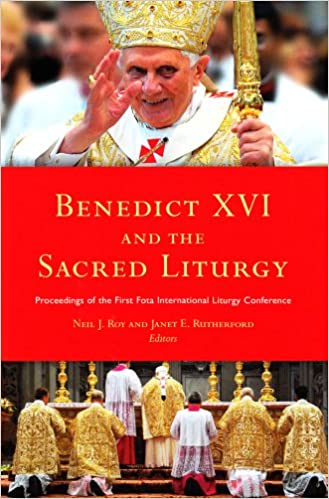 | Benedict XVI and the Sacred Liturgy By Neil J. Roy (Editor), Janet E. Rutherford (Editor). Four Courts Press (June 2010) Benedict XVI and the Sacred Liturgy is the published proceedings of the first Fota International Liturgical Conference held in Cork, Ireland, in July 2008 and it aims to provide a general overview of some of the more important themes in Benedict XVI’s liturgical writings. It serves as a broad introduction to issues central to Benedict XVI's concern for authentic renewal of Catholic worship, according to the principles set out by the Second Vatican Council, and to his critique of liturgical innovations deviant from those principles. The book explores some of the formative influences on Joseph Ratzinger's liturgical vision and points to the consistent application of those critically assimilated influences over a spectrum of issues facing modern liturgical scholarship: the recovery of the sacred, the cosmic and eschatological dimensions of Christian worship, advocacy of continuity rather than rupture in the liturgical tradition; the need for historical and intellectual honesty in discerning development (as well as in areas such as vernacular translations of the core texts of the Roman Rite); and the renewal of genuine scientific exploration of the sources of the Roman Rite. The book is aimed at a professional and general audience. For the most part, it is easily accessible and plots the map for a series of more specific issues to be dealt with in the Fota Liturgical Conference Series. |
 | Pope Benedict XVI and the Sexual Abuse Crisis: Working for Reform and Renewal Our Sunday Visitor (May 17, 2010) "You have suffered grievously and I am truly sorry. I know that nothing can undo the wrong you have endured."----- Pope Benedict XVI The True Story Since 1985, the Catholic Church in the United States has been living in the shadow of the clerical sexual abuse crisis. In 2002, revelations in Boston ignited an institutional nightmare. More recently, the scandal erupted in Ireland and spread across Europe. There is now a rush by some, both inside and outside the Church, to place direct blame upon Pope Benedict XVI. There is no escaping the fact that Pope Benedict, as the former head of the Congregation for the Doctrine of the Faith and now as pope, has played an historically pivotal and personal role in the Vatican's response to the crisis. Pope Benedict XVI and the Sexual Abuse Crisis is a groundbreaking, critically objective assessment of the criticism facing the pope as well as a review of his real response to the victims, abusers, bishops, media, and the millions of Catholics worldwide who continue to be justifiably horrified by the scandal. The first and foremost objective for this book is the truth no matter how difficult to face and letting the pope's record speak for itself. "No one imagines that this painful situation will be resolved swiftly. Real progress has been made, yet much more remains to be done." Pope Benedict XVI. Review
|
 | The Social and Political Thought of Benedict XVI By Thomas Rourke. Lexington Books (January 2010) Covering the entire trajectory of his religious life, this meticulously researched book identifies the roots of political and social order in Pope Benedict XVI's philosophy and analyzes his views on the role of Christian faith in politics. Although not generally characterized as a political philosopher, the Benedict's writings shed significant and unique light on the world of politics today. In an age when modern politics has lost sight of its proper relationship within the larger scheme of human affairs and existence, Thomas R. Rourke shows that, as both Pope and the former Cardinal Ratzinger, Benedict has made a conscious effort to relate political issues to the broader dialogue on human endeavor, ethics, and culture. Bringing to the fore Benedict's belief on the necessary place of the Christian tradition in a contemporary politics of reason, Rourke details the Pope's contribution to solving the deeper problems of politics today. A valuable study in political theory and religion, this book should be read by those interested in Catholic social and political thought. Thomas R. Rourke is chair of the political science and philosophy department at Clarion University. Related
|
 | Covenant and Communion: The Biblical Theology of Pope Benedict XVI By Scott Hahn. Baker Brazos Press (October 2009). 208 pages. Cardinal Joseph Ratzinger's election as Pope Benedict XVI brought a world-class biblical theologian to the papacy. There is an intensely biblical quality to his pastoral teaching and he has demonstrated a keen concern for the authentic interpretation of sacred Scripture. Here a foremost interpreter of Catholic thought and life offers a probing look at Benedict's biblical theology and provides a clear and concise introduction to his life and work. Bestselling author and theologian Scott Hahn argues that the heart of Benedict's theology is salvation history and the Bible and shows how Benedict accepts historical criticism but recognizes its limits. The author also explains how Benedict reads the overall narrative of Scripture and how he puts it to work in theology, liturgy, and Christian discipleship. Related
|
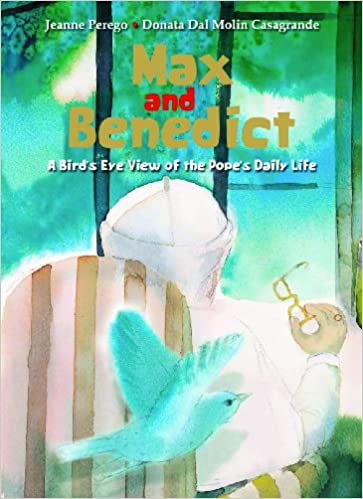 | Max and Benedict: A Bird's Eye View of the Pope's Daily Life By Jeanne Perego (Author), Donata Casagrande (Illustrator). Ignatius Press (October 2009) This lovely children's book is a sequel to Joseph and Chico, the international best seller that told the story of the life of Pope Benedict XVI from his youth to his election as the Pope. With the same award-winning author and illustrator, this lavishly illustrated book is aimed at children but in a way that even adults will enjoy. It takes up the story of Benedict XVI's new life as the Pope. The narrator of this book is a blue rock-thrush that spends most of his time on the dome of Saint Peter's Basilica and in the Vatican gardens. The bird's scientific name is Monticola Solitarius, and it really lives in these places. His name is Max, and from his solitary perch, Max observes everything in the vicinity, and he is fascinated by one human in particular: the Pope. Max tells readers what the Pope does on a typical day, and also about special moments in his life, such as the Pope's apostolic trips. The book provides a delicate portrait of the Holy Father's many responsibilities, and it helps us understand the Pope's important obligations that he always strives to carry out with love, faith and dedication. Max talks about the Pope's private and public audiences, his meetings with heads of state, and with children, important liturgical moments, and the Angelus. He also describes more curious events, such as the blessing of the lambs and of a fire truck. He tells us about the moments that the Pope devotes to writing and prayer. Max flies to see the Pope at his Summer home, Castel Gandolfo, and is sorry he cannot accompany him on his important apostolic trips, but is happy each time the Pope returns to the Vatican. Max is also delighted when he sees the Pope relax a bit, playing the piano or strolling through the Vatican gardens. Max loves music, too, and many of his friends live in the Vatican garden. Through this wonderful story, the author presents some of the fundamental ideas of Pope Benedict XVI, and the important daily life and activities of the successor of St. Peter, told in simple words that young readers can understand and enjoy. |
 | Pope Benedict XVI: An Introduction to His Theological Vision by Reverend Thomas P Rausch S.J. Ph.D. Paulist Press (March 2009). 195 pages. From professor and scholar, to the Vatican’s enforcer of the faith and, finally, to the throne of St. Peter, Cardinal Joseph Ratzinger/Pope Benedict XVI has become for the world the public face of the Roman Catholic Church. Rev. Thomas P. Rausch, S.J.—the T. Marie Chilton Professor of Catholic Studies at Loyola Marymount University in Los Angeles—tells us he has been reading and studying Ratzinger’s work since 1969. With this book, Rausch provides a clear and concise overview of the pope’s life and theological vision on several levels: his Eucharistic ecclesiology, his theology of liturgy, his Christology and “his relentless refusal to reduce Sacred Scripture to mere history or literature.” As Benedict’s writings on contentious issues within the church (e.g. liberation theology, women, homosexuality et al.) and the world (human rights, solidarity, religious pluralism et al.) reflect, Rausch notes that “[Benedict’s] tendency is to speak the way a university professor does, isolating difficulties with a particular clarity and force.” The author expresses concern, though, on the pope’s ability to read the signs of the times, as it were, as he seeks to “rearticulate Catholic doctrine in the context of secular culture.” -- America Reviews
|
 | Benedict XVI: An Intimate Portrait By Peter Seewald. Ignatius Press (October 30 2008). 260 pages. In the person of Pope Benedict XVI, one of the most significant of Europe's intellectuals is heading-up the Vatican. The journalist Peter Seewald, who has known Ratzinger since 1992, conducted the "longest interviews in church history" with him, for two books which were best-sellers world-wide, Salt of the Earth, God and the World. Now he describes these intensive encounters in detail for the first time, and draws a portrait of this brilliant theologian who has put his life entirely at the service of the Catholic Church. Above and beyond that, this book is also the story of a long dialogue which changed Seewald's life. Many people are trying to understand who Benedict XVI really is. On one point they are all agreed: in the person of Joseph Ratzinger, the chair of Peter is occupied by one of the most brilliant minds in the world. Peter Seewald's portrait of Benedict recounts details about the personality and life of Benedict which were hitherto completely unknown. Excerpts
Reviews
|
 | Christ, Our Joy: The Theological Vision of Pope Benedict XVI By Joseph Murphy. Ignatius Press (May 2008). 220 pages. Noticing how often the new Pope had the topic of "joy" as the central theme of his many addresses, Murphy delved into the vast writings of the Pope, before and after his election to the papacy, and found that the theme of joy has pervaded all of his theology. Recognizing the Pope's invitation to joy as a key to understanding his basic theological vision, Murphy develops those ideas and writings in a creative way, and helps the reader to engage personally with the original and pastoral mind of Joseph Ratzinger, professor, pastor, and now Pope Benedict XVI. This joy is nothing other than the joy of the Christian faith. Indeed, the "first word of the New Testament", says Pope Benedict XVI, "is an invitation to joy". The Gospel of Jesus Christ, he insists, is not a burdensome imposition but is truly "glad tidings" for mankind. Christianity is the key to true and lasting joy, the only joy that abides in the midst of life's anxieties and difficulties. Written in a clear and engaging style, this book argues that joy is central to all of Pope Benedict's thought. All the other great themes of the Christian faith are intimately connected with it and radiate out from it. The world is in need of hearing once again the message of joy which Jesus Christ makes known. Related
|
 | Creation and Evolution: A Conference With Pope Benedict XVI in Castel Gandolfo Stephan Otto Horn, S.D.S., and Siegfried Wiedenhofer | Translated by Michael J. Miller | Foreword by Christoph Cardinal Schönborn. Ignatius Press (May 2008). 200 pages. In 2005 the Archbishop of Vienna, Christoph Cardinal Schönborn wrote a guest editorial in The New York Times that sparked a worldwide debate about "Creation and Evolution". Pope Benedict XVI instructed the Cardinal to study more closely this problem and the current debate between "evolutionism" and "creationism," and asked the yearly gathering of his former students to address these questions. Even after Joseph Ratzinger became Pope Benedict XVI, he has continued to maintain close contact with the circle of his former students. The "study circle" (Schulerkrers) meets once a year with Pope Benedict XVI for a conference. Many of these former Ratzinger students have gone on to become acclaimed scholars, professors and writers, as well as high ranking Church prelates. This book documents the proceedings of the remarkable conference on the topic of "Creation and Evolution" hosted by Pope Benedict XVI in 2006 at the papal summer residence, Castel Gandolfo. It includes papers that were presented from the fields of natural science, philosophy and theology, and records the subsequent discussion, in which Pope Benedict XVI himself participated. "Ultimately it comes down to the alternative: What came first? Creative Reason, the Creator Spirit who makes all things and gives them growth, or Unreason, which, lacking any meaning, strangely enough brings forth a mathematically ordered cosmos, as well as man and his reason. The latter, however, would then be nothing more than a chance result of evolution and thus, in the end, equally meaningless. As Christians, we say: I believe in God the Father, the Creator of heaven and earth. I believe in the Creator Spirit. We believe that at the beginning of everything is the eternal Word, with Reason and not Unreason." -- Pope Benedict XVI "Creation and Evolution is an extraordinary opportunity for the public to listen in on the conversation as some of the greatest minds in the Catholic Church -- theologians, philosophers, scientists, and Pope Benedict himself -- wrestle with one of the most thorny and far-reaching of topics. Participants clash repeatedly over what we really know about the forces that shaped life on earth, over what is data and what is hype, over what certain scenarios might mean even if they were true. I recommend it to anyone who wants to know where we might have come from and where we might be headed. -- Michael J. Behe, Lehigh University, Author of The Edge of Evolution. |
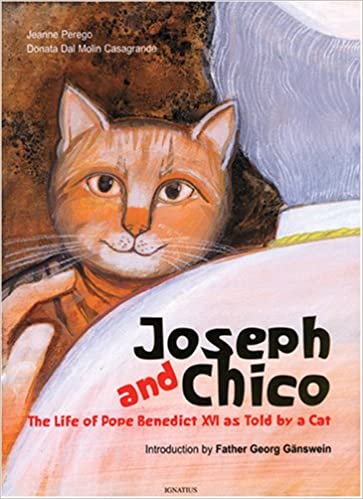 | Joseph and Chico: The Life of Pope Benedict XVI as Told By a Cat by Jeanne Perego (Author), Donata Dal Molin Casagrande (Illustrator), Georg Ganswein (Introduction). Ignatius Press (March 2008) In this beautifully illustrated book for children, Chico the cat describes the life of his "best friend", Pope Benedict, in this authorised biography of the Pope for young people approved by the Vatican. "Dear Children, here you will find a biography that is different than others because it is told by a cat and it is not every day a cat can consider the Holy Father his friend and sit down to write his life story," the Pope's personal secretary, Monsignor Georg Ganswein, says in the foreword. The Pope is known for his fondness of animals, especially cats, and Joseph and Chico is narrated by Chico, a real cat who took up with the Pope in his native Germany long before he became the Pope. Chico tells the story of the life of "my best friend" from his birth in Germany in 1927, through his days as a young man, priest, bishop and cardinal. With a colorful and sometimes amusing language, the author makes this funny cat tell us about the life of the young Joseph all the way up to his election as Pontiff on April 19, 2005. It recounts the Nazi era in Germany when the Pope was a teenager, calling the war years "one of the most dramatic and shameful times in the history of man". Later when he became Cardinal Ratzinger, Chico recounts how each time when the Cardinal returned to Germany from Rome for a vacation, the cat would run into his house and sit on his lap as he played the piano. Related
|
 | Ratzinger's Faith: The Theology of Pope Benedict XVI By Tracy Rowland. Oxford University Press, USA (March 6, 2008). 224 pages. A popular reading of Joseph Ratzinger (Benedict XVI) is that he started out as a progressive but had second thoughts after the cultural revolution of the late 1960s. A more negative portrait is that of an ambitious and intellectually precocious young man who changed theological allegiances for the sake of promotion within the Catholic hierarchy. Now, in this probing book, Tracey Rowland offers a third reading, one that situates the thought of Pope Benedict within the intellectual history and academic circles of his time. The first serious assessment of the new Pope's theological vision, this thoughtful volume covers topics such as the interpretations of the Second Vatican Council, Pope Benedict's relations with other important scholars and theologians, and his attitudes on moral and political theology, western culture, the structure of the Catholic Church, liturgy, and love. It has become a commonplace observation that Pope Benedict has been influenced by the thought of St. Augustine in contrast to many of his predecessors in the papacy who were much more strongly influenced by St. Thomas Aquinas. This work therefore addresses the topic of in what way Benedict is an Augustinian. The volume also includes a bibliography arranged thematically for those who want to explore his thought more deeply in a particular area. A penetrating account of the thought of the reigning pontiff, this volume offers a wealth of insight for everyone interested in Pope Benedict and the direction of the modern Catholic Church. Reviews
|
 |
Benedict of Bavaria: An Intimate Portrait of the Pope and His Homeland By Brennan Pursell. Ignatius Press (March 2008). 240 pages. An Intimate Portrait of the Pope and His Homeland Highlighting a little-known personal side of Joseph Ratzinger, Pope Benedict XVI, this book places him in the context of his homeland, Bavaria a place which the author, Brennan Pursell, has come to know well through extensive travel and study over the last twelve years. Explore the extraordinary brilliance of Pope Benedict's mind and the universality of his vocation within the context of his identity as a simple son of his beloved homeland, Bavaria. Includes color photos and a rare look at a day in the life of the Pope. |
 | Joseph Ratzinger - Life in the Church and Living Theology: Fundamentals of Ecclesiology by Maximilian Heinrich Heim. (Ignatius Press, October 2007). 500pp. This is a major work on the theology of Joseph Ratzinger, now Pope Benedict XVI, by a highly regarded German theologian, priest and writer. Since his election to the Papacy, Ratzinger's theology, and in particular his ecclesiology (theology of the Church), has been in the limelight of theological and ecumenical discussions. This important work studies in detail Ratzinger's ecclesiology in the light of Vatican II, against the ongoing debate about what Vatican II really meant to say about the life of the Church, its liturgy, its worship, its doctrine, its pastoral mission, and more. Has his theology of the Church changed since Vatican II, or has it continued to develop consistently? Is the Catholic Church one church among many churches? Is she the object of hope or a historical reality? Ratzinger the theologian figures centrally in this investigation, not as the former Prefect for the Congregation for the Doctrine of the Faith, but as a thinker and as a writer Related
|
 | An Invitation to Faith: An a to Z Primer on the Thought of Pope Benedict XVI Edited by Jean-michel Coulet Ignatius Press (July 2007). 110 pages. As soon as he was elected to the Papacy, Benedict XVI immediately challenged the relativism of our times that rejects God, that sees noting as definitive, and that, according to the Pope, sets as the ultimate yardstick the individual's own ego and desires alone. The Pope offers instead an opposing standard: Christ, the Son of God, the true man. The Pope's words are rousing and demand an examination of conscience. His words are meant for all. With strong words, Benedict XVI invites us to place God at the center of our lives. Thus, this book is a selection of key words from the teachings of the Holy Father since he began his Pontificate, presented in alphabetical order. Each key word leads to an inspiring and insightful meditation from the Pope on various important spiritual themes and topics. Benedict XVI invites us in these words to become daily actors in the real revolution that comes from God and is called Love. This volume is a handy little primer on the thought of the beloved Pontiff in which the reader can pick out any key word or topic form the alphabetical order of meditations throughout the book to meditate and focus on. |
 | Pope Benedict XVI: The Conscience of Our Age By Fr. Vincent Twomey Ignatius Press (April 2007). 220 pages. Fr. Vincent Twomey, a former doctoral student of Joseph Ratzinger, and a long time friend of the Pope's, felt the need to respond to the common question he read and heard often after Ratzinger's papal election, "What kind of person is the new Pope?" Twomey offers here a unique double-presentation of the man, Pope Benedict XVI -- a "theological portrait" that encompasses both an overview of the writings, teachings and thought of the brilliant theologian and spiritual writer, as well as the man himself, and his personality traits and how he communicates with others. Since Ratzinger came in to the papacy already well known and highly regarded as one of the greatest theologians of our age, and having written so much on almost every theological subject touching on the faith, morality, the Church and State, it is important to know his mind on these topics and how he approaches the major spiritual and social issues of our times. Twomey shows his style is really the opposite of how he has been depicted in the past -- that he is indeed very pastoral and will first win the hearts of people who will then read for themselves his writings. His very first encyclical, God Is Love, underscores that approach. Twomey shows that the secret to the serene dignified behavior of Benedict is that, as a man who is an accomplished pianist, he is open to beauty as much as truth, that he lives outside himself, and is not preoccupied with his own self. He also is a man that Twomey says "has the courage to be imperfect", showing he has a deep humility and strives for teaching the truth even when misunderstood or not presented as well as he would like. Excerpts / Related Links
Reviews
|
 | The Regensburg Lecture By James V. Schall, SJ. St. Augustines Press (April 2007). 180 pages. Overshadowed by the violent reaction and rioting throughout the world, the September 12, 2006, lecture by Pope Benedict XVI at Regensburg, Germany, at the university where he once taught, is a multifaceted and brilliant speech that addresses the very nature of man’s understanding of a free conscience, his thirst for knowledge in both reason and revelation, his understanding of the limitations of the will, and the nature of his ability to understand his neighbor. It explains the Church’s historical claims that Christ himself is Logos (as the opening of John’s Gospel proclaims), a term meaning “word,” “logic,” and “speech.” One’s faith is to be grounded in a self-limiting God, Who does not capriciously change the rules on humans but Who reveals himself to our reason as well as our hearts. A God Who respects His own creation enough to give man free will, and thus a free conscience and an ability to fail; Who leads man, through both reason and revelation, to Himself, always in peace and never in violence; Who is a God of Life, not Death. The lecture is a mere eight single-spaced pages of text, but it encapsulates not only theoretical history of the Church, but touches on the most poignant current problems the world witnesses, namely, the rise of terrorism and the confrontation between reason and will, between the Word and the Sword. Though incredibly timely, it is as timeless as the Gettysburg Address, Pericles’ Funeral Oration, Plato’s Apology, and Henry V’s Speech on St. Crispin’s Day. No doubt it will be studied and read for generations to come, not only by Catholics, not only by Christians, but by men of good will the world over. So it is fitting that our world’s modern G.K. Chesterton – James Schall – has chosen to explicate this most-important work by the world’s premier theologian on the thorniest, most divisive questions of our day. Jim Schall, throughout the hundreds upon hundreds of books, articles, and reviews he has written, has always, like Chesterton, maintained a graceful and accessible touch, a clear and memorable style, that makes light work from heavy sources. He is the perfect person to explain both the central concepts and the importance of this amazing speech. Reviews
|
 | The Way of Love: Reflections on Pope Benedict XVI's Encyclical Deus Caritas Est Ignatius Press (December 2006) In response to Benedict XVI's first encyclical, the Pontifical John Paul II Institute for Studies and Marriage and Family reflects, together with the Holy Father, on love. From the very beginning, the fundamental work of the Institute has been pursuing a deeper understanding of God's plan for marriage and family. In these twenty-five years various generations of students and professors, following the legacy of John Paul II, have been able to discover and communicate the beauty of the vocation for which all men have been created: the call to love. Twenty-six professors from the Institute's various sessions express what in their understanding are the main themes of the document, approaching the topics raised by the Holy Father with different theological and philosophical perspectives; by so doing they have highlighted the significance and fecundity of the lines of thought suggested by the Pope. This book is offered as a path towards a fuller understanding of the profundity and richness of the love with which God fills us and wants us to communicate in our turn. |
 | The Rule of Benedict : Pope Benedict XVI and His Clash with the Modern World by David Gibson. HarperSanFrancisco (September 2006). In this detailed examination, Gibson tells how Cardinal Ratzinger became Pope Benedict XVI, and why his ways of thinking about the church may not bode well for efforts to reform it in such areas as governance and opening the priesthood to women or married men. He paints the new pontiff as someone who is more interested in the personal piety of Catholics than their engagement with the world and issues of social justice. - Publisher's Weekly Reviews
|
 | God's Choice: Pope Benedict XVI and the Future of the Catholic Church By George Weigel. Harper Collins (November 2005). 320 pages. George Weigel's bestselling biography of Pope John Paul II, Witness to Hope, set the standard by which all portraits of the modern papacy are now measured. With God's Choice, he gives us an extraordinary chronicle of the rise of Pope Benedict XVI as well as an unflinching view of the Catholic Church at the dawn of a new era. When John Paul II lapsed into illness for the last time, people flocked from all over the world to pray outside his apartment. He had become a father figure to millions in a world bereft of strong paternal examples, and those millions now felt orphaned. After more than twenty-six years of John Paul II's guidance, the Catholic Church is entering a new age, with its bedrock traditions intact but with pressing questions to address in a rapidly changing world. Beginning with the story of John Paul's final months, God's Choice offers a remarkable inside account of the conclave that produced Benedict XVI as the next pope, drawing on George Weigel's unrivaled access to this complex event. Weigel also incisively surveys the current state of the Church around the world: its thriving populations in Africa, Latin America, and parts of the post-communist world; its collapse in western Europe; its continued struggles in Asia; and the vibrancy of many aspects of Catholic life in the United States, even as the Church in America struggles to overcome its recent experience of scandal. Reviews
|
 | Thought of Pope Benedict XVI: An Introduction to the Theology of Joseph Ratzinger By Fr. Aidan Nichols. Burns & Oates (June, 2005). 352 pages. Aidan Nichols' timely book is the first full-scale investigation of Joseph Ratzinger's theology in its development from the 1950s to the present day. It presents a chronological account of the development of Ratzinger's writing which reflects a wide range of historical and theoretical interests such as: Augustine's ecclesiology; early Franciscanism and the idea of salvation history; Christian brotherhood; the unfolding of the Second Vatican Council; commenting on the Apostles' Creed; explorations of the concept of the Church; preaching, liturgy and Church music; eschatology; the foundations of dogmatic and moral theology; the Church and politics; ecumenism, and the problem of pluralism. This book is a comprehensive introduction to a figure who is in his own right, quite apart from his significance in the politics of the Church, a major German Catholic theologian of the twentieth century. This new edition provides an amplification of the existing chapters by reference to books and articles produced by Joseph Ratzinger between 1986/1987 and his election as Pope in 2005. This is especially important in the area of the Liturgy, where his 1999 study 'The Spirit of the Liturgy' takes further his critique of contemporary Western Catholic worship and his call for a new liturgical movement which would aim to 'reform the Reform'. Nichols also includes two wholly new chapters devoted to (a) Ratzinger's writings on Judaism, Islam and other religions, as well as (b) secularization and the future of Europe. |
 | Looking again at the Question of the Liturgy with Cardinal Ratzinger Edited by Alcuin Reid OSB. St. Augustine's Press (January 2004). 160 pages. "What we previously knew only in theory has become for us a practical experience: the Church stands and falls with the Liturgy. When the adoration of the divine Trinity declines, when the faith is no longer appears in its fullness in the Liturgy of the Church, when man's words, his thoughts, his intentions are suffocating him, then faith will have lost the place where it is expressed and where it dwells. For that reason, the true celebration of the Sacred Liturgy is the centre of any renewal of the Church whatever." -- Joseph Cardinal Ratzinger But how, today, at the beginning of the third millennium, do we achieve "the true celebration of the Liturgy"? Is the answer a wholesale return to the traditional rites? Is it in accepting a wide diversity of divergent uses -- new, old and inculturated -- in the Roman rite? Or is it in seeking an official reform of the liturgical reform that followed the Second Vatican Council? These are the issues that were discussed under the presidency of Cardinal Ratzinger at the conference held at the Abbey of Notre-Dame at Fontgombault from July 22-24 2001. This volume makes available in English translation the papers from that conference -- papers which inform and challenge, and which make a significant contribution to the consideration of the question of the Liturgy in our day. Reviews
|
Books About Joseph Ratzinger [Pope Benedict XVI]
 is published by Manga Hero and is available on Amazon.com.

Subscribe to:
Posts (Atom)