

|
Christ, Our Joy: The Theological Vision of Pope Benedict XVI by Joseph Murphy. Ignatius Press (May 2008). Noticing how often the new Pope had the topic of "joy" as the central theme of his many addresses, Murphy delved into the vast writings of the Pope, before and after his election to the papacy, and found that the theme of joy has pervaded all of his theology. Recognizing the Pope's invitation to joy as a key to understanding his basic theological vision, Murphy develops those ideas and writings in a creative way, and helps the reader to engage personally with the original and pastoral mind of Joseph Ratzinger, professor, pastor, and now Pope Benedict XVI. This joy is nothing other than the joy of the Christian faith. Indeed, the "first word of the New Testament", says Pope Benedict XVI, "is an invitation to joy". The Gospel of Jesus Christ, he insists, is not a burdensome imposition but is truly "glad tidings" for mankind. Christianity is the key to true and lasting joy, the only joy that abides in the midst of life's anxieties and difficulties. Written in a clear and engaging style, this book argues that joy is central to all of Pope Benedict's thought. All the other great themes of the Christian faith are intimately connected with it and radiate out from it. The world is in need of hearing once again the message of joy which Jesus Christ makes known. Related
|
Christ, Our Joy: The Theological Vision of Pope Benedict XVI


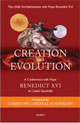
Creation and Evolution: A Conference With Pope Benedict XVI in Castel Gandolfo
|
Creation and Evolution: A Conference With Pope Benedict XVI in Castel Gandolfo Stephan Otto Horn, S.D.S., and Siegfried Wiedenhofer | Translated by Michael J. Miller | Foreword by Christoph Cardinal Schönborn. Ignatius Press (May 2008). In 2005 the Archbishop of Vienna, Christoph Cardinal Schönborn wrote a guest editorial in The New York Times that sparked a worldwide debate about "Creation and Evolution". Pope Benedict XVI instructed the Cardinal to study more closely this problem and the current debate between "evolutionism" and "creationism," and asked the yearly gathering of his former students to address these questions. Even after Joseph Ratzinger became Pope Benedict XVI, he has continued to maintain close contact with the circle of his former students. The "study circle" (Schulerkrers) meets once a year with Pope Benedict XVI for a conference. Many of these former Ratzinger students have gone on to become acclaimed scholars, professors and writers, as well as high ranking Church prelates. This book documents the proceedings of the remarkable conference on the topic of "Creation and Evolution" hosted by Pope Benedict XVI in 2006 at the papal summer residence, Castel Gandolfo. It includes papers that were presented from the fields of natural science, philosophy and theology, and records the subsequent discussion, in which Pope Benedict XVI himself participated. "Ultimately it comes down to the alternative: What came first? Creative Reason, the Creator Spirit who makes all things and gives them growth, or Unreason, which, lacking any meaning, strangely enough brings forth a mathematically ordered cosmos, as well as man and his reason. The latter, however, would then be nothing more than a chance result of evolution and thus, in the end, equally meaningless. As Christians, we say: I believe in God the Father, the Creator of heaven and earth. I believe in the Creator Spirit. We believe that at the beginning of everything is the eternal Word, with Reason and not Unreason." -- Pope Benedict XVI "Creation and Evolution is an extraordinary opportunity for the public to listen in on the conversation as some of the greatest minds in the Catholic Church -- theologians, philosophers, scientists, and Pope Benedict himself -- wrestle with one of the most thorny and far-reaching of topics. Participants clash repeatedly over what we really know about the forces that shaped life on earth, over what is data and what is hype, over what certain scenarios might mean even if they were true. I recommend it to anyone who wants to know where we might have come from and where we might be headed. -- Michael J. Behe, Lehigh University, Author of The Edge of Evolution. |